How Do Scientists Measure the Complexity of Humpback Whale Songs?
Humpback whales produce some of the most elaborate vocal displays found among marine mammals. Their songs can contain repeated sounds, changing pitches, rhythmic patterns, and sequences that develop over time. These vocalizations have attracted scientific interest because they offer researchers an opportunity to investigate how whales produce and organize underwater sounds.
But how can scientists determine whether one whale song is more complex than another?
The answer involves more than counting the number of sounds a whale makes. Researchers can examine the variety of acoustic units, the organization of sound sequences, the frequency of repetition, and the amount of variation within a recording. They may also use mathematical models and computer-assisted tools to describe patterns that are difficult to assess through listening alone.
Understanding these measurements helps explain how scientists study humpback whale communication. It also offers another way to appreciate the whales that visit Samaná Bay in the Dominican Republic during the breeding season.
What Does Song Complexity Mean in Humpback Whales?
Song complexity describes measurable features of how sounds are produced and organized. It is not a single characteristic that can be evaluated in exactly the same way for every research question.
A song containing many different sound units may be considered more diverse in one analysis. Another study might focus on how those units are arranged into sequences or how frequently the sequence changes.
For example, imagine two hypothetical recordings.
The first recording contains a small number of sound types repeated in a relatively consistent order. The second contains a larger variety of sounds arranged into several different sequences.
Under a measurement focused on sound diversity, the second recording might score higher. Under another measurement focused on repetition or predictability, the result could be different.
This is why scientists need to define what they mean by complexity before comparing recordings.
Song complexity also should not be confused with loudness, duration, or emotional significance. A longer song is not automatically more complex, and a more complicated acoustic pattern does not necessarily communicate more information.
1. Counting the Variety of Sound Units
One straightforward approach is to examine how many distinct sound-unit types occur within a recording.
Humpback whale songs may contain sounds with different frequency contours, durations, rhythms, and acoustic textures. Researchers can classify recurring units and determine how many different categories appear in a selected sample.
Suppose a recording contains ten identified sound-unit types, while another contains six. If both recordings are analyzed using the same classification rules and comparable sampling methods, the first contains greater observed unit diversity.
However, raw counts have limitations. A longer recording will often contain more opportunities to capture additional sound types. Researchers therefore need to compare recordings of suitable lengths or use methods that account for differences in sampling effort.
Classification also matters. If analysts divide similar sounds into too many categories, diversity may appear artificially high. If they group genuinely different sounds together, diversity may appear lower than it really is.
A consistent classification method makes the results more useful.
2. Measuring How Sound Units Are Arranged
The organization of sounds is another important aspect of song complexity.
Scientists may examine how individual units combine into short sequences, phrases, or larger song structures. They can investigate whether certain units tend to occur together, whether particular sequences repeat, and how the song moves from one section to another.
Consider two hypothetical songs that contain the same five sound types.
In the first song, the units occur in a simple repeated sequence. In the second, the same units appear in several different arrangements.
Although both songs contain the same number of sound types, their sequential structures differ. A measurement that focuses on sequence diversity could distinguish between them.
Researchers may use annotated recordings to identify these arrangements and then compare the resulting sequences mathematically.
This approach is useful because it recognizes that a song's structure depends not only on the sounds present but also on the relationships between them.
3. Examining Repetition and Predictability
Repetition is a recognizable feature of humpback whale song. Researchers can measure how often particular sounds or sequences occur and how predictable one unit is after another.
A recording in which the same sequence is repeated many times may have lower variation under certain measurements than a recording containing a wider range of sequences.
One statistical concept that can help describe this variation is entropy.
In information theory, entropy measures uncertainty in a probability distribution. Applied carefully to acoustic sequences, it can help researchers quantify how predictable or varied particular sound patterns are.
For example, if one sound consistently follows another, the transition may be highly predictable. If several different sounds can follow the same unit with similar frequencies, the next sound may be less predictable.
Scientists can calculate these patterns using different approaches, including measurements of individual sound units or relationships between consecutive units.
Importantly, higher entropy is not automatically evidence of greater biological complexity. It may reflect greater variation, recording noise, overlapping sounds, or a different choice of analysis method. Researchers need to interpret the measurement within its scientific context.
4. Studying Song Length Without Confusing It With Complexity
Song duration is relatively easy to measure, but its relationship to complexity requires careful interpretation.
A humpback whale may produce a long sequence that includes substantial repetition. Another whale may produce a shorter sequence with a greater variety of sound units or transitions.
If scientists use duration alone, they would miss these structural differences.
Researchers can measure the total recording length, the duration of identified units, the length of repeated sequences, and the time spent on particular song components.
They may then combine these measurements with information about diversity and sequence organization.
It is also important to distinguish the duration of a recording from the duration of the whale's complete song. An underwater recorder may capture only part of a performance, particularly when the whale moves away or background conditions make the remaining sounds difficult to detect.
A short recording should not automatically be interpreted as a short or simple song.
5. Using Spectrograms to Examine Acoustic Detail
Scientists often use spectrograms to visualize underwater recordings.
A spectrogram displays sound energy across time and frequency. It can reveal tonal sounds, rising and falling frequency contours, repeated pulses, and other features relevant to song analysis.
These visual patterns help researchers distinguish acoustic units and measure properties such as duration, frequency range, and changes in pitch.
For complexity research, spectrograms can help analysts determine whether two apparently similar sounds share comparable structures or contain meaningful differences.
However, spectrograms depend on settings such as time resolution, frequency resolution, and the processing applied to the recording. Different settings can emphasize different features.
Researchers must choose appropriate settings and use consistent procedures when comparing samples. They should also recognize that visual patterns do not independently explain what a sound means to a whale.
Spectrograms provide evidence about acoustic structure, not a direct translation of whale communication.
6. Applying Mathematical Models to Song Sequences
Once recordings have been divided into identifiable units, researchers can represent songs as sequences of symbols or measurable acoustic features.
This makes it possible to apply mathematical techniques to large datasets.
For example, a sequence might be represented as A-B-A-C, where each letter represents an identified sound-unit category. Another sequence could be A-C-B-A.
Researchers can compare the sequences to examine how often units repeat, how many different transitions occur, and how much the patterns differ.
Some studies may use transition probabilities to describe how likely one unit is to follow another. Others may use sequence comparisons or statistical models to measure variation.
More advanced methods can examine dependencies that extend beyond the immediately preceding sound.
The appropriate method depends on the research question. A simple count may be sufficient for one purpose, while another question may require a model that accounts for longer sequences and repeated structures.
Mathematical models help make comparisons more consistent, but the quality of the results still depends on the accuracy of the original recordings and sound classifications.
7. Comparing Complexity Between Individual Whales
Scientists may also investigate whether song complexity differs among individual whales.
This requires recordings that can be reliably associated with individual animals. Researchers may use visual observations, photo-identification, or other supporting evidence where available.
If recordings cannot be assigned confidently to individual whales, scientists must avoid interpreting every recording as a separate animal.
Even when individuals are identified, comparisons can be complicated by differences in recording duration, behavioral context, and the portion of the song captured.
A whale recorded for several minutes may appear to produce more sound types simply because the researchers observed a larger sample.
Researchers can reduce this problem by comparing equivalent portions of recordings, standardizing sampling where possible, and accounting for uncertainty in their analyses.
Such comparisons may reveal individual differences, but they do not automatically establish why those differences occur.
8. Investigating Changes in Song Complexity Over Time
Humpback whale songs are not necessarily fixed patterns. Their structure can change over different periods, and researchers may investigate how measurements of complexity vary across recordings collected at different times.
For example, scientists might examine whether the variety of sound units changes across a study period or whether particular sequences become more or less common.
To interpret such changes, researchers need comparable data. Recordings collected using different equipment, under different noise conditions, or with unequal sampling effort may produce misleading differences.
A sound type may also appear to disappear simply because it was not captured in a later recording.
Researchers can address these challenges through consistent acoustic processing, repeated sampling, and statistical methods that account for uncertainty.
The aim is to identify patterns supported by the recordings rather than assume that every change in a complexity measurement represents a change in whale behavior.
9. Does a More Complex Song Mean a More Intelligent Whale?
This is an important question, but acoustic complexity alone cannot answer it.
A song with more sound types or a greater number of possible sequences is not necessarily evidence of higher intelligence. Complexity is only one measurable property of a vocal display.
Interpreting cognitive ability would require additional evidence and a clear explanation of how the acoustic measurements relate to the specific cognitive process being investigated.
The same caution applies to claims about emotion, communication success, or social importance. A complicated song does not automatically have a more important message, and a simple song is not necessarily less useful.
Researchers can investigate possible functions of whale singing by combining acoustic analysis with observations of behavior, environmental conditions, and social context.
Keeping these questions separate helps ensure that scientific conclusions remain grounded in the available evidence.
10. Why Song Complexity Research Matters in Samaná Bay
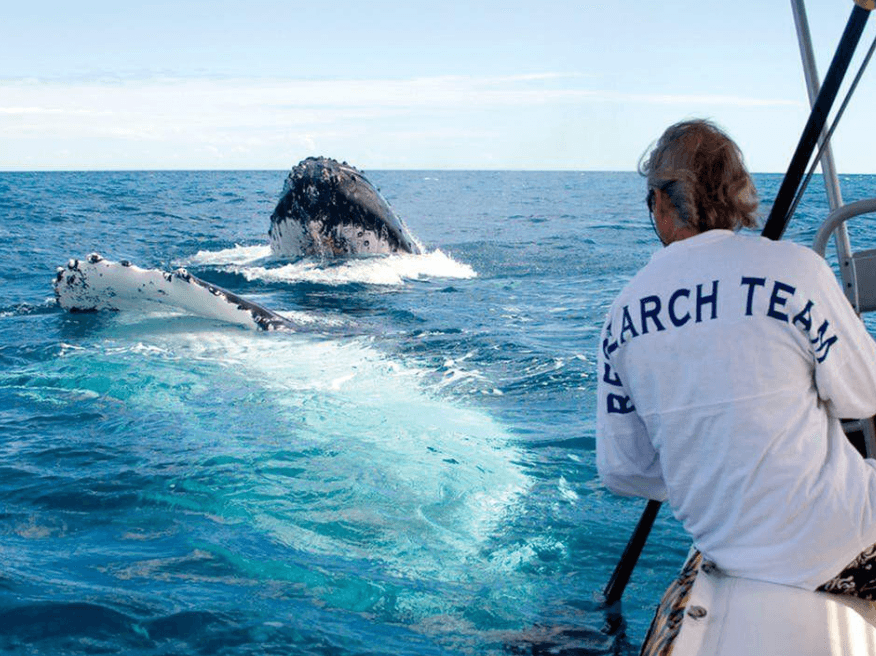
Samaná Bay is widely known as a destination for observing humpback whales during the breeding season. Visitors may encounter whales at the surface, observe their movements, and learn about their migration and behavior.
Song complexity research explores another part of humpback whale biology: the organization of underwater sounds.
Suitable acoustic recordings from Samaná could potentially be analyzed for sound-unit diversity, sequence structure, repetition, and other measures of complexity. Researchers could then compare the findings with appropriate datasets from other locations or periods.
However, it is important not to assume that a particular complexity pattern has been established for Samaná whales without a verifiable study supporting that conclusion.
Seeing a whale surface from a tour boat does not reveal the full structure of its underwater song. Detailed acoustic research requires appropriate recording equipment, careful analysis, and sufficient data.
For travelers, this adds another dimension to the whale-watching experience. The animals visible from the surface are also producing sounds and engaging in behaviors that scientists continue to investigate using specialized methods.
When visiting Samaná, choose responsible whale-watching operators that follow applicable wildlife-viewing rules and give whales appropriate space. Respectful observation supports a better experience for visitors while minimizing unnecessary disturbance to the animals.
What Scientists Can Learn From Measuring Whale Song Complexity
Measuring humpback whale song complexity requires several complementary approaches. Researchers may count distinct sound units, examine sequence organization, measure repetition and predictability, study acoustic features, and apply statistical models to larger datasets.
No single measurement captures every aspect of a song. The most informative analyses define their objectives clearly, use consistent methods, and account for recording limitations.
These techniques can help scientists describe how whale songs are structured and how their patterns vary across recordings. They cannot, on their own, establish the meaning of a song or determine a whale's intelligence.
For Samaná and other important humpback whale habitats, acoustic research offers a valuable way to investigate aspects of whale behavior that are not directly visible during ordinary wildlife encounters.
The more carefully researchers measure these underwater patterns, the more precisely they can describe humpback whale songs—and identify the questions that still need further study.
Frequently Asked Questions
How do scientists measure humpback whale song complexity?
They may measure sound-unit diversity, sequence structure, repetition, predictability, acoustic variation, and other features. The measurements selected depend on the research question.
Are longer humpback whale songs more complex?
Not necessarily. A long song may repeat a limited set of patterns, while a shorter song may contain more varied sequences. Duration and complexity should be measured separately.
What is entropy in whale song research?
Entropy is a mathematical measure of uncertainty in a probability distribution. In song analysis, it can help describe how predictable or varied sound patterns are, depending on the method used.
Can scientists determine the meaning of a whale song from its complexity?
No. Acoustic complexity describes measurable features of a song, but it does not automatically reveal meaning. Understanding possible functions requires additional evidence.
Do all humpback whales produce equally complex songs?
Not necessarily. Songs and individual recordings may differ in sound variety and structure. Researchers must account for sampling, recording conditions, and other factors before comparing them.
Can humpback whale song complexity be studied in Samaná Bay?
Yes, suitable underwater recordings from Samaná could be analyzed using established acoustic methods. However, conclusions about local song complexity require actual recordings and a properly documented study.
Why do scientists study humpback whale songs?
Studying songs helps researchers describe acoustic behavior, investigate patterns of variation, and develop questions about communication and social behavior. The findings contribute to a broader understanding of humpback whales.

Local explorer & expert guide in Glamping Los Haitises.