How Do Tour Guides Estimate the Distance to a Humpback Whale in Samaná Bay?
When a humpback whale appears in Samaná Bay, Dominican Republic, one of the first questions passengers often ask is, “How far away is it?”
Judging the distance between a whale and a tour boat can be surprisingly difficult. The ocean has few familiar reference points, the whale may remain visible for only a short time, and waves can make its position appear to change.
Experienced whale-watching guides use observation skills, knowledge of the surrounding water, and information about the boat’s position to assess a sighting. Although their estimates can help passengers understand what they are seeing, judging distance by eye is not perfectly precise.
Understanding how this process works can make a Samaná whale-watching trip more educational while highlighting an important principle: observing whales responsibly is more important than getting as close as possible.
Why Is Whale Distance Difficult to Judge?
On land, people can estimate distance by comparing an object with familiar features such as buildings, roads, or trees. At sea, those reference points may be missing.
A humpback whale can surface against an uninterrupted background of water and sky. Without a nearby object of known size, passengers may struggle to tell whether the animal is relatively close or farther away.
Several factors contribute to this challenge.
1. The Ocean Has Few Familiar Reference Points
Open water provides limited visual information about distance. A whale seen against a distant horizon may appear deceptively close or far away.
Even a large animal can look small when viewed from a distance. Conversely, a whale surfacing near the boat may appear much larger because more of its body is visible.
Guides learn to interpret these visual cues through experience, but a visual impression alone cannot establish an exact measurement.
2. Waves Can Change the View
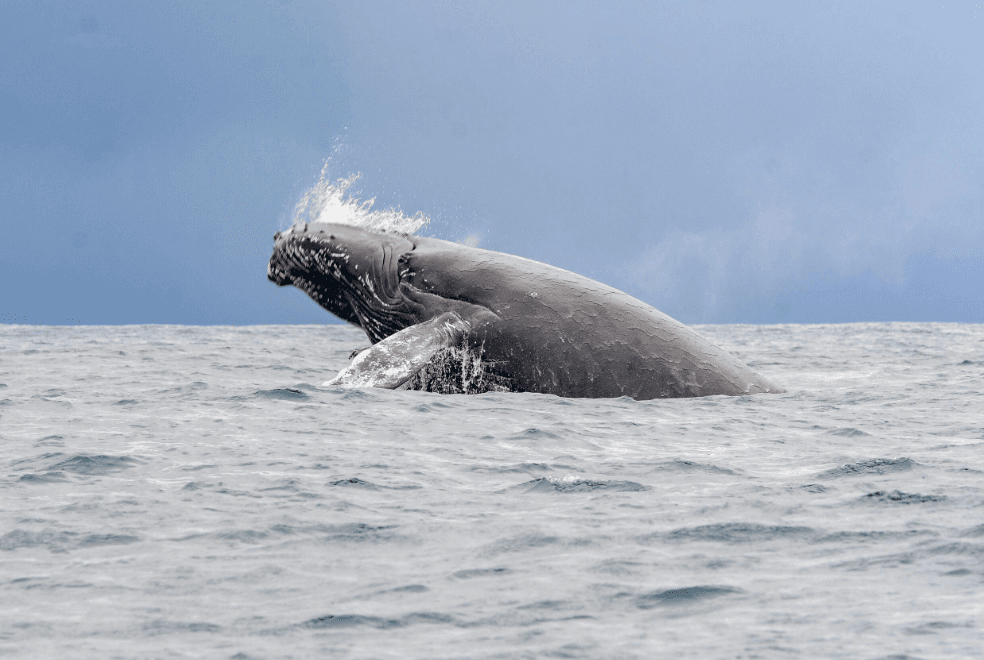
The sea surface is constantly moving. Waves can temporarily hide parts of a whale, interrupt the view of its back, or make it difficult to track the animal between surfacings.
A whale may also disappear beneath the water, leaving passengers uncertain about its location. When it surfaces again, it may be in a different position.
For this reason, guides must consider the overall sighting rather than relying on one brief glimpse.
3. Lighting and Visibility Affect Perception
Bright sunlight, glare, haze, and changing cloud cover can influence how clearly passengers see a whale.
When the outline of an animal is difficult to distinguish, estimating its distance becomes more challenging. A whale may appear less distinct because of the viewing conditions rather than because it is especially far away.
Guides account for these limitations when interpreting sightings and helping passengers locate animals on the water.
How Do Whale-Watching Guides Estimate Distance?
There is no single visual trick that works in every situation. Guides can combine several observations to develop a reasonable understanding of a whale’s position.
1. They Observe the Whale’s Position Relative to the Boat
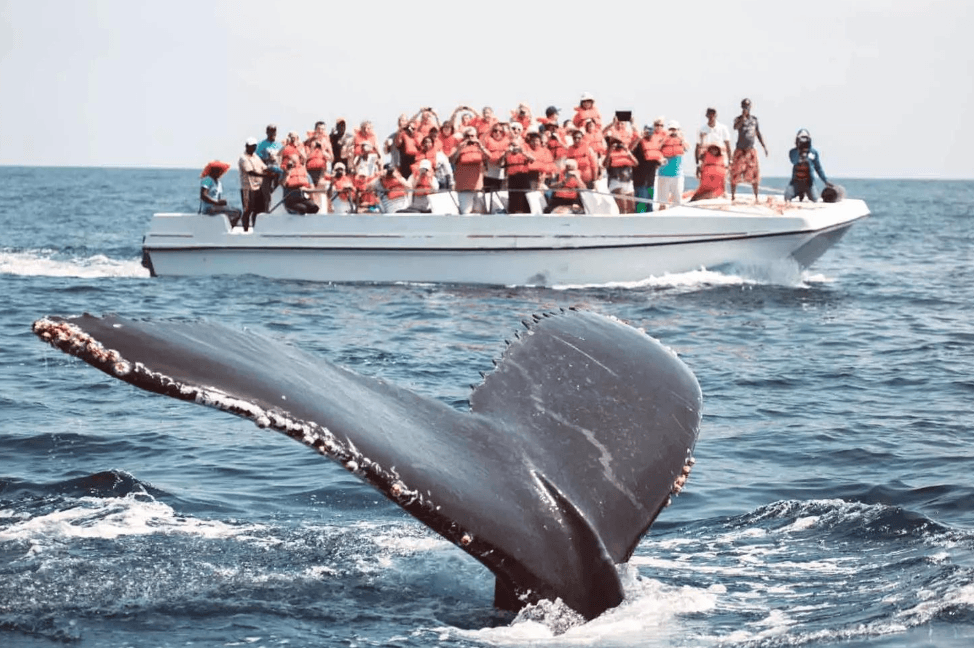
The boat provides an important reference point. Guides observe where the whale surfaces relative to the vessel and how that position changes over time.
For example, a whale may initially appear ahead of the boat and later surface off to one side. This change can indicate movement by the whale, the boat, or both.
However, relative position is not the same as an exact distance. A guide must consider the boat’s movement and the whale’s movement together.
2. They Track the Whale Across Multiple Sightings
A single surfacing may provide limited information. Watching the whale across several surfacing events can help guides understand its approximate location and direction of movement.
If the whale disappears underwater, guides may continue observing the surrounding area and look for its next appearance.
This approach helps maintain awareness of the animal without requiring the boat to rush toward the last place it was seen.
3. They Use Experience With the Local Environment
Guides who regularly work in Samaná Bay become familiar with the area’s viewing conditions, common whale-sighting situations, and the practical limitations of observing animals from a boat.
Experience can improve their ability to interpret a sighting, particularly when visibility is good and the whale remains in view.
Nevertheless, familiarity with the bay does not eliminate uncertainty. Guides should not present a visual estimate as an exact measurement unless it has been established using a reliable method.
4. They Consider the Boat’s Position and Movement
A boat that is drifting, turning, or moving forward changes the passengers’ perspective.
A whale may appear to move across the view even when much of the apparent movement comes from the vessel. Similarly, a whale swimming in a different direction may change the distance between itself and the boat.
Responsible operators account for these factors when managing their position during a sighting.
Depending on the equipment and procedures available, a crew may also use navigational information to support its assessment. Passengers should not assume that every tour boat uses electronic equipment to measure the exact distance to a whale.
Can Passengers Estimate Whale Distance Too?
Passengers can learn to notice the same general visual clues that guides use, but their estimates should be treated as approximations.
Here are a few useful ways to observe a sighting:
- Look at the entire scene. Notice the whale’s position relative to the boat, horizon, and surrounding water.
- Watch for repeated appearances. Several sightings may reveal changes in position that are not obvious at first.
- Pay attention to the viewing conditions. Waves, glare, and poor visibility can make distance judgments less reliable.
- Listen to the guide’s explanation. The crew may have a better understanding of the boat’s position and the sighting conditions.
- Avoid guessing based on size alone. A whale’s apparent size can be misleading when there is no clear reference object.
Binoculars can help you see details of a whale from a distance, but magnification does not independently tell you how far away the animal is.
The goal is to improve your observation skills, not to produce an exact measurement from appearance alone.
Why Does Distance Matter for Responsible Whale Watching?
Distance is more than a practical navigation question. It is an important part of responsible wildlife observation.
Humpback whales are wild marine mammals that need space to move, surface, travel, and interact with other whales. A boat that approaches too closely or follows an animal aggressively may disturb its natural behavior.
Responsible whale-watching operators follow applicable local regulations and guidance governing vessel approach, speed, and proximity to whales.
Maintaining an appropriate distance can also benefit passengers. A respectful viewing position may provide a broader view of the animal without creating unnecessary pressure on the whale or encouraging unsafe maneuvers.
Getting a closer photograph is never more important than the animal’s welfare.
What Happens When a Whale Is Difficult to Locate?
Humpback whales spend time underwater between surfacing events. When a whale disappears, its next location may not be immediately obvious.
A responsible guide may continue scanning the area, wait for another sighting, or adjust the boat’s position in accordance with applicable wildlife-viewing rules.
Passengers should avoid pressuring the crew to chase a whale or move closer simply because it has disappeared.
A sighting may resume after a short wait, or the whale may move beyond the viewing area. Neither outcome means that the trip has failed.
Whale watching is an experience with wild animals, so sightings and viewing conditions naturally vary.
Does a Closer Whale Always Provide a Better Experience?
Not necessarily.
A whale that is clearly visible from a respectful distance can provide an excellent opportunity to observe its body shape, surfacing behavior, and movement through the water.
Sometimes, a more distant sighting offers a better view of the surrounding environment or allows passengers to observe several whales without focusing on only one animal.
Photography also depends on more than distance. Lighting, camera equipment, the movement of the boat, and the whale’s position all affect the final image.
Instead of judging a tour by how close the boat gets, consider the quality of the observation, the guide’s explanations, the crew’s safety practices, and the care taken to avoid disturbing wildlife.
Questions to Ask Your Samaná Whale-Watching Guide
If you want to understand more about distance and responsible observation, consider asking your guide:
- How do you keep track of a whale when it disappears underwater?
- What makes distance difficult to judge on open water?
- How do local rules influence the boat’s approach to whales?
- What should passengers watch for when a whale surfaces again?
- How can we photograph whales without encouraging the boat to approach too closely?
These questions can turn an exciting sighting into a learning opportunity while helping you understand the decisions the crew makes throughout the trip.
Frequently Asked Questions
Can a guide know the exact distance to a humpback whale by looking at it?
Visual observation can provide an estimate, but it does not guarantee an exact measurement. Lighting, waves, visibility, and the movement of the whale and boat can all affect perception.
Do whale-watching boats use technology to measure distance?
Equipment and procedures vary by operator. Navigational tools may help crews understand the vessel’s position, but passengers should not assume that every boat can electronically measure the precise distance to an individual whale.
Why can a whale appear closer than it really is?
The lack of familiar reference points at sea can make distance difficult to judge. A large animal against an open horizon may create a misleading impression of proximity.
Should a whale-watching boat move closer for photographs?
The crew should prioritize applicable regulations, safe navigation, and responsible wildlife-viewing practices. Passengers should never pressure a captain to approach a whale too closely for a photograph.
What should I do if I cannot see the whale clearly?
Follow your guide’s directions, scan the area calmly, and wait for another opportunity to observe the animal. Binoculars may help you see more detail, but patience is often the most useful tool.
Final Thoughts
Estimating the distance to a humpback whale in Samaná Bay requires careful observation and an understanding of the challenges of viewing wildlife on open water.
Guides consider the whale’s position, repeated sightings, boat movement, visibility, and their experience with local conditions. These clues can help them interpret an encounter, but visual estimates are not always exact.
For visitors, learning how distance is judged offers a new way to appreciate the skill involved in whale watching. It also reinforces an essential principle: the best encounters are those that respect the whales and their natural environment.
When you join a Samaná whale-watching trip, listen to your guide, observe the whole scene, and enjoy the opportunity to see these remarkable animals without expecting the boat to get as close as possible.

Local explorer & expert guide in Glamping Los Haitises.